Documentary voice-over: AI voice or a human narrator?
AI voice-over versus a human narrator for YouTube documentaries: cost, speed, consistency, emotion, languages and the effect on the edit. Which suits which channel, and what to watch in AI voices.
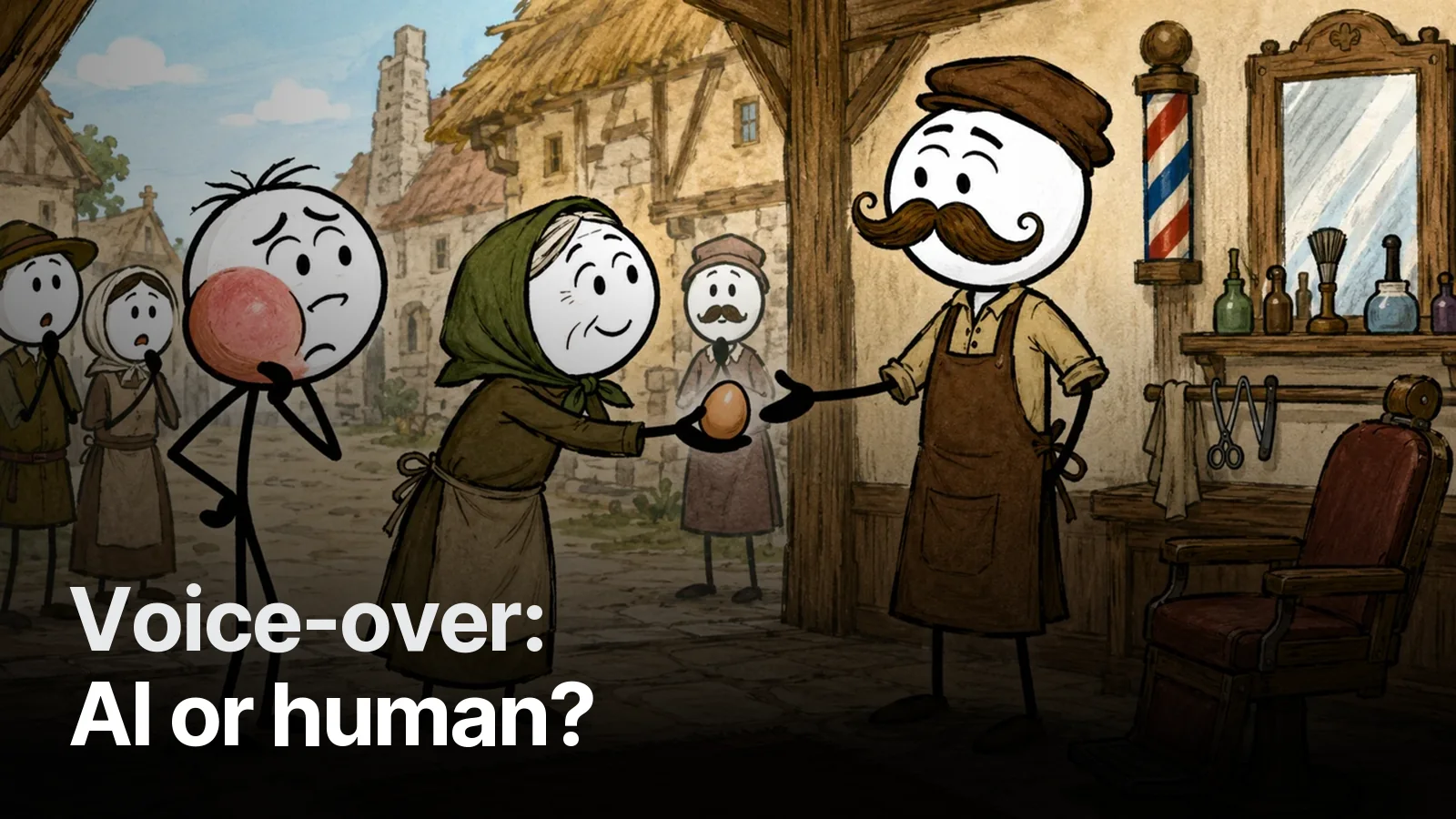
On a faceless channel the voice is the channel's face. There are two routes: an AI voice, or a human narrator (or the creator's own voice). We have edited episodes with both; the right call depends on the topic and the channel's personality.
Comparison
| AI voice-over | Human narrator | |
|---|---|---|
| Cost | Low | Medium–high |
| Speed | Minutes | Days of recording + fixes |
| Consistency | Identical episode to episode | Depends on day, mic, mood |
| Emotion and personality | Enough with a good voice, limited | Strong |
| Revisions | Regenerate one sentence | New recording needed |
| Multiple languages | Same script, other languages | A separate voice per language |
When an AI voice
- Calm, information-led documentaries (economics, history, technology, health).
- Series that ship more than one episode a week.
- The same video in English and Turkish.
The parenting channel got a calm English AI voice, and the edit — one scene per sentence — was set to that voice's pace.
When a human voice
- When the creator's personality is the brand.
- When the channel leans on storytelling, humour or improvisation.
- When viewers come because they know that voice.
Five things we watch in AI voices
- Prepare the text for speech. Numbers, years, abbreviations and foreign names are written the way they should be read.
- One voice per channel. The chosen voice and settings never change across the series.
- Pauses. Sentence ends and chapter breaks need a natural breath; an unbroken stream tires. We extend pauses from the silent region of the waveform, never mid-word.
- Emphasis. The key number or word goes at the start or end of the sentence; the cut lands on it.
- Mix. Voice around −14 LUFS with music below it; harsh sibilance softened.
Effect on the edit
Whatever the voice, the edit is built on its word timings. So the voice-over must be locked before editing starts; a voice that changes mid-edit shifts every cut. The process: how a documentary episode is made.
Leave the voice-over to us or send your own recording — both work: Video & YouTube editing.
Frequently asked
1.Is AI voice-over good enough for a YouTube documentary?
For calm, information-led documentaries it is often enough, and perfectly consistent. For channels where emotion and personality lead — storytelling, the creator's own voice — a human voice is stronger.
2.What is the most common problem with AI voices?
Breathless, unbroken flow. Without natural pauses at sentence ends and chapter breaks, viewers tire. We extend pauses in the edit by reading the audio's energy.
3.Can the same voice stay across a whole series?
Yes; the channel gets one voice and one settings preset, used in every episode. The tone doesn't drift across the series.
4.Can you make the same video in two languages?
Yes. With an AI voice the same script can be voiced in English and Turkish, and since on-screen text is set in code, the edit is adapted without typos.