Sound design for YouTube documentaries: ducking, risers, impacts and −14 LUFS
How sound is built in documentaries and explainers: music ducked under the voice, breathing room at chapter breaks, risers and impacts, sound-effect layers, and a −14 LUFS mix for YouTube. Plus a note on copyright-safe music.
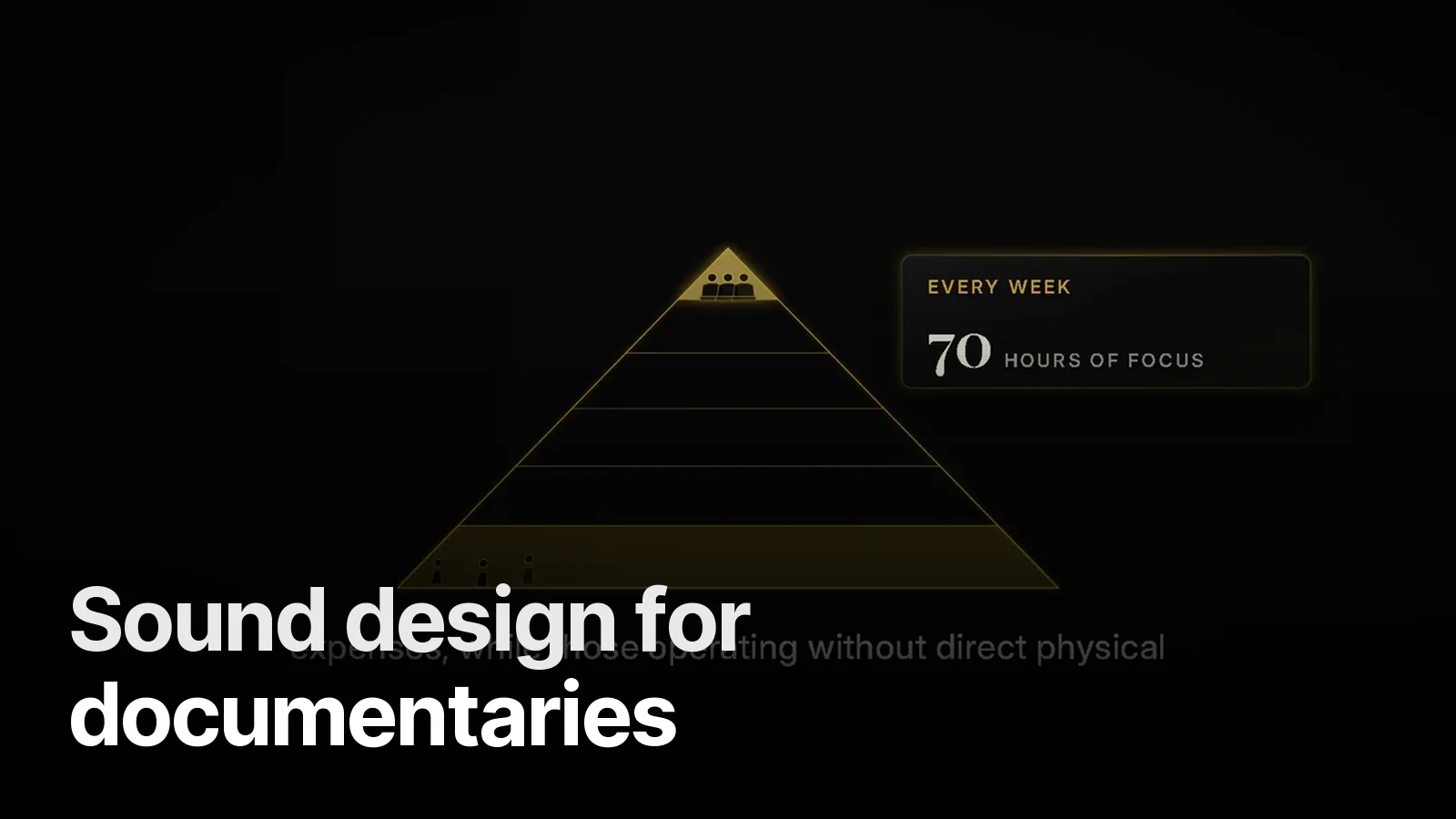
The picture pulls viewers in; the sound keeps them. On a phone speaker or headphones, a sound mistake closes a documentary faster than a picture mistake. These are the layers of our audio edit.
1. The voice on top
Everything serves intelligibility. The voice-over is cleaned (noise, harsh sibilance) and levelled. Music and effects never rise above a word.
2. Music: ducking and breath
Music dips while the narrator speaks (ducking), lifts slightly between sentences, and steps forward at chapter breaks to let the viewer breathe. The rhythm rule: a long pause at chapter breaks, a short one between sentences.
| Moment | Music |
|---|---|
| Narration | Low, under the voice |
| Between sentences | Lifts slightly |
| Chapter break | Steps forward, 1–2 s breath |
| Tension | Riser → impact |
| Close | The theme returns |
3. Risers and impacts
The moment a number is revealed, a comparison turns or a question lands: a rising riser ending in an impact. In Ferrari vs Lamborghini these hits replaced wall-to-wall music, and the tension built itself.
4. The sound-effect layer
Every movement on screen has a sound: a whoosh as a graphic enters, a tick on a counter, a thud as a stamp lands, paper as a page turns. They aren't overdone, but their absence is felt at once — silent animation looks cheap. In our stickman videos every move of the character is tied to a sound.
5. Music made for the channel
Library music works, but it plays on other channels too. We composed a calm piano bed for the parenting channel; the noir documentary came with its own noir score. Channel-specific music gives recognition and copyright safety.
6. Mix: −14 LUFS
YouTube pulls playback to about −14 LUFS. Deliver louder and it is turned down and loses dynamics; deliver quieter and the video sounds weaker than the next one. Peaks below −1 dBTP. Before delivery we listen on a phone speaker and on headphones.
Four common mistakes
- Music covering the voice.
- The whole video at one level, with one track.
- Effects clipping.
- Silent transitions — animation happens, no sound.
Sound design comes with every documentary edit we do: Video & YouTube editing. The editing rhythm rules: retention editing.
Frequently asked
1.What loudness should a YouTube video be?
YouTube normalises playback to roughly −14 LUFS. Delivering the mix around −14 LUFS with peaks below −1 dBTP means it plays without being turned down or clipping.
2.What is ducking?
Music automatically dipping while the narrator speaks and rising back when they stop. The music is felt but never covers a word.
3.Should a documentary have music all the way through?
Usually not. Music at one constant level tires the ear. Music steps forward at chapter breaks and sits low during narration; in some documentaries bass hits and sound effects at tension points work better than music.
4.How do you avoid music copyright problems?
We use licensed library music or music produced for the channel. We composed the parenting channel's piano bed ourselves, so there are no Content ID claims.