Designing armor rarity tiers for a game: Common to Legendary in 3D
How to make players feel each upgrade: silhouette, material and colour rules for armor rarity tiers, shown on a real 14-tier set (female + male, Common to Holy) built as modular, swap-in-place 3D parts.
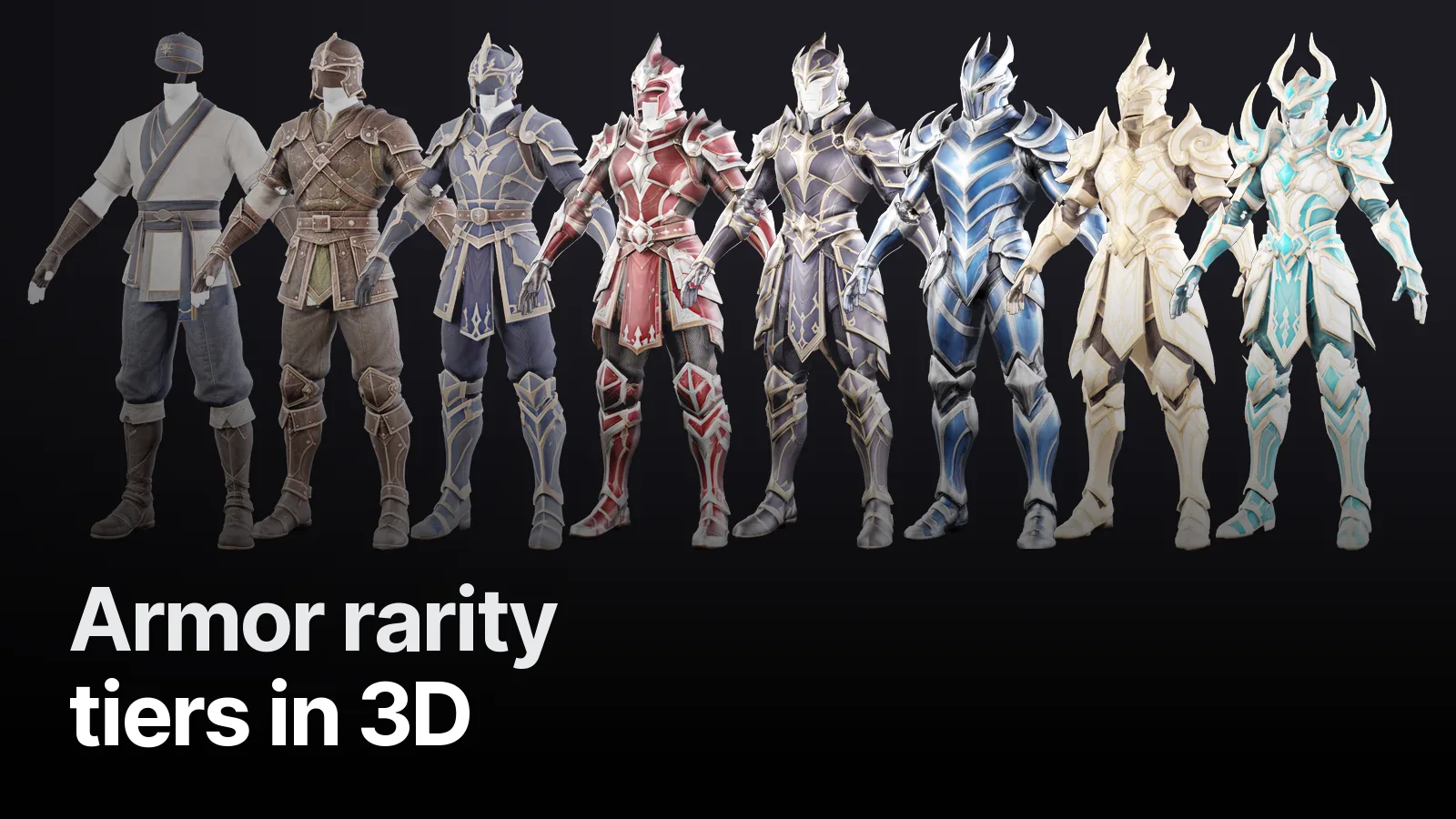
In an RPG, armor is the progress bar the player wears. If the upgrade from Rare to Epic doesn’t look like an upgrade, loot loses its pull. Below is how we approached a 14-tier armor set — six female and eight male tiers, from Common cloth to three levels of Holy plate. Full set: Armor tier sets.
Silhouette carries the tier
Read the line-up from left to right:
- Common — a cloth tunic, wrapped belt, cloth cap. Soft, close to the body.
- Uncommon — leather, straps, riveted knee and shoulder pieces, a simple open helmet.
- Rare — the first full plate: closed helmet, layered pauldrons, a tabard.
- Epic — red and silver, sharper edges, plates start to break the body line.
- Legendary — purple and gold trims, a crested helmet, a heavier skirt of plates.
- Holy I–III — white, blue and turquoise; pauldrons grow into wing-like shapes and the helmet gains horns.
At thumbnail size you can still sort them — that is the test.
Material before colour
Each step changes the material family: cloth → leather → steel → enamelled plate → ornamented plate → glowing ceremonial armor. Colour reinforces it (red for Epic, purple-gold for Legendary), but a player who can’t tell red from green still sees the tier.
Built to swap
Every tier is aligned to the same base body and split into the same parts: helmet, chest, gloves, pants, boots. That means:
- the game swaps tiers without re-rigging,
- parts can mix (a Legendary helmet over Rare boots) if the design allows it,
- one skeleton and one set of animations serve all fourteen.
Female and male, same ladder
The female line runs Common to Holy I, the male line continues to Holy III. Both share the same tier logic, so a player recognises “Epic” on either character instantly.
Checklist for your own tiers
- Can you sort the tiers from silhouettes alone?
- Does each tier change material, not just colour?
- Are all tiers aligned to one base body, split into the same parts?
- Is the top tier special enough to chase?
More game work: game projects · Related: RPG / MMO character design · Outsourcing 3D game art
Frequently asked
1.How should armor change from Common to Legendary?
Silhouette first, then material, then colour. Common is soft cloth close to the body; each tier adds hard surfaces, bigger pauldrons and a taller helmet; top tiers add glow, trims and shapes that break the body outline. A player should read the tier from across the screen.
2.Should rarity colours follow the usual grey-green-blue-purple-gold scheme?
Players already know that code, so it helps — but it works best as a secondary signal on trims and gems. The main signal is the silhouette, which also keeps the tiers readable for colour-blind players.
3.What does 'swap in place' mean for armor sets?
Every tier is aligned to the same base body and split into the same parts — helmet, chest, gloves, pants, boots — so the game can swap one tier for another without re-rigging or repositioning.
4.Can you produce armor and equipment sets for our game?
Yes. Send your art style, engine, target platform and the tier list; we start with one tier on your base body for approval and build the ladder from there.